
NCERT Solutions for Class 6 Science Chapter 2
Let us enhance our learning (pages 31-33)
Q1. Here are two types of seeds. What differences do you find among the roots and leaf venation of their plants?
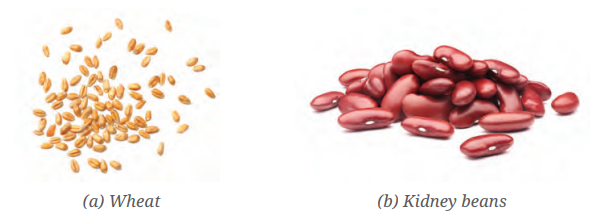
ANS: The kidney bean plant has a taproot system and reticulate venation in its leaves, whereas the wheat plant has fibrous roots and parallel venation. Thus, they differ in both root type and leaf venation.
Q2. Names of some animals are given below. Group them based on their habitats. Write the names of aquatic animals in the area marked ‘A’ and terrestrial animals in the area marked ‘B’. Enter the names of animals living in both habitats in part ‘C’. Horse, Dolphin, Frog, Sheep, Crocodile, Squirrel, Whale, Earthworm, Pigeon, Tortoise
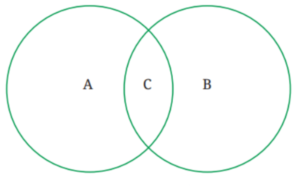
ANS: Aquatic animals (A): Dolphin, Whale
Terrestrial animals (B): Horse, Sheep, Squirrel, Pigeon, Earthworm
Both habitats (C): Frog, Crocodile, Tortoise
Q3. Manu’s mother maintains a kitchen garden. One day, she was digging out radish from the soil. She told Manu that radish is a kind of root. Examine a radish and write what type of root it is. What type of venation would you observe in the leaves of radish plant?
ANS: Type of Root : Tap root
Type of venation : Reticulate.
Q4. Look at the image of a mountain goat and a goat found in the plains. Point out the similarities and differences between them. What are the reasons for these differences?
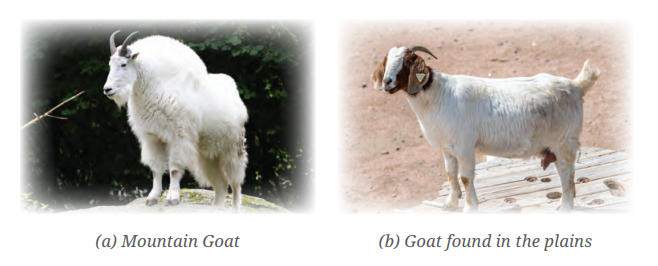
ANS: Similarities:
Both are goats and belong to the same family.
Both are herbivores and eat plants like grass, leaves, and stems.
Both have four legs, horns, and similar body structure.
| Mountain Goat | Plains Goat |
|---|---|
| Has thick, long fur to protect against cold mountain temperatures | Has shorter fur suited for warmer climates |
| Generally stockier and more muscular, adapted for climbing rocky terrains | Leaner build suitable for flat, open areas |
| Has specialised hooves with rough texture for better grip on rocky surfaces | Hooves more suited for walking on flat, grassy lands |
Q5. Group the following animals into two groups based on any feature other than those discussed in the chapter— cow, cockroach, pigeon, bat, tortoise, whale, fish, grasshopper, lizard.
ANS: We can group these animals into two groups based on whether they have wings or not.
- Animals with wings: Pigeon, Bat, Cockroach, Grasshopper
- Animals without wings: Cow, Tortoise, Whale, Fish, Lizard
Q6. As the population grows and people want more comfortable lives, forests are being cut down to meet various needs. How can this affect our surroundings? How do you think we can address this challenge?
ANS: Effects on surroundings:
Cutting forests leads to loss of habitat for plants and animals.
It causes a decrease in biodiversity.
It disturbs the ecological balance.
It increases problems like soil erosion and climate change.
Ways to address the challenge:
Plant more trees (afforestation).
Reduce cutting of forests (deforestation).
Use natural resources wisely.
Spread awareness about protecting the environment.
Q7. Analyse the flowchart. What can be examples of ‘A’ and ‘B’?
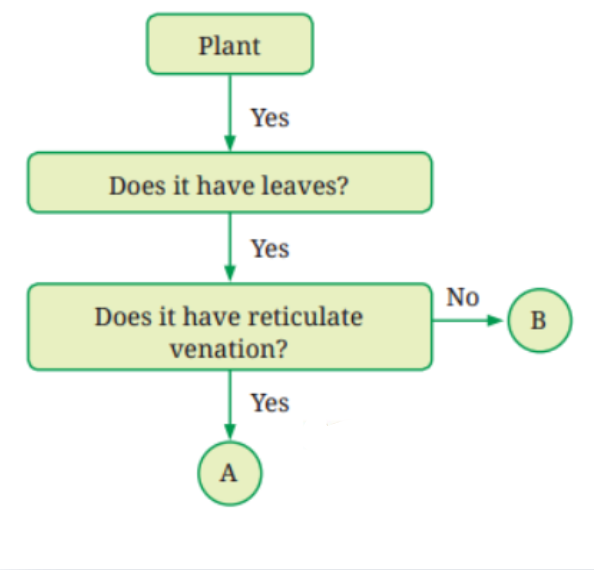
ANS: A:- Plants that have leaves with reticulate venation also have taproots.
Examples: Mango, Hibiscus, Mustard
B:- Plants that do not have reticulate venation (i.e., have parallel venation) have fibrous roots.
Examples: Wheat, Grass, Maize
Q8. Raj argues with his friend Sanjay that “Gudhal (hibiscus) plant is a shrub.” What questions can Sanjay ask for clarification?
Ans: Sanjay can ask following questions:-
1. What is the nature of its stem?
2. What is the height of the Gudhal (hibiscus) plant?
3. Is the stem of the Gudhal plant woody?
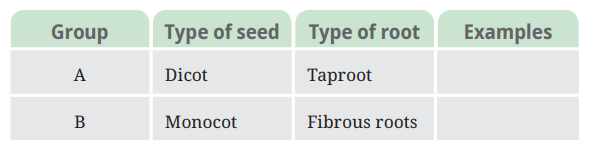
9. Based on the information in the table, find out examples of these plants for each group.
Ans:
| Group | Type of seed | Type of root | Example |
| A | Dicot | Taproot | Gram, beans, bottle ground, mango, Mustard, peas, Hibiscus |
| B | Monocot | Fibrous root | Wheat, rice, maize, grass |
(a) What other similarities do plants of group A have?
ANS:
Leaves show reticulate venation.
Seeds have two cotyledons.
Roots are taproots.
Leaves are generally broad.
(b) What other similarities do plants of group B have?
ANS:
Leaves show parallel venation.
Seeds have one cotyledon.
Roots are fibrous roots.
Leaves are generally long and narrow.
Q10. Observe the labelled part of a duck in the picture given below. What differences do you observe in the feet of the duck compared to the other birds? Which activity would the duck be able to perform using this part?
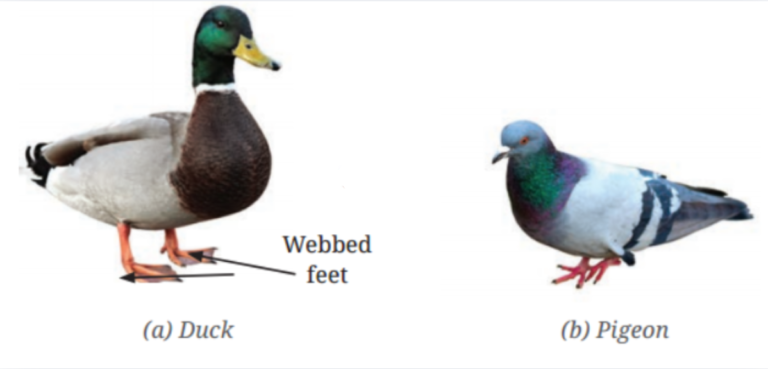
ANS: The duck has webbed feet, unlike other birds which have separate toes. These webbed feet help the duck to swim easily in water.