
NCERT Class 6 Social Science Chapter 6 Questions and Answers
THE BIG QUESTIONS (Page No. 85)
Q1: What is a civilisation?
Answer: A civilisation is a large and complex society that has developed advanced forms of social organisation, culture, government, and technology. It includes the following key features:
Cities: Civilisations have large and well-planned cities where people live, work, and interact in an organised manner.
Government: They have a system of administration and rules to manage society, maintain order, and take collective decisions.
Writing: Civilisations develop writing systems to keep records, communicate ideas, and preserve knowledge.
Technology: They use advanced tools, techniques, and skills in areas such as construction, agriculture, and crafts.
Culture: Civilisations have shared traditions, art, beliefs, customs, and social practices that give them a distinct identity.
Q2: What was the earliest civilisation of the Indian Subcontinent?
Answer: The earliest civilisation of the Indian Subcontinent was the Harappan civilisation, also known as the Indus civilisation or the Indus-Sarasvatī civilisation. It developed around 2600 BCE in the north-western regions of the Indian Subcontinent, along the banks of the Indus River and the Sarasvatī River. This civilisation was one of the oldest and most advanced civilisations of the ancient world.
Q3: What were its major achievements?
Answer: The Indus Valley Civilisation had several major achievements that made it one of the most advanced civilisations of the ancient world:
Urban Planning and Architecture: The civilisation is famous for its well-planned cities built on a grid pattern. Cities such as Harappa and Mohenjo-daro had straight roads, systematically arranged houses, and buildings constructed with baked bricks. The presence of separate residential and public areas shows advanced town planning.
Advanced Drainage System: One of the most remarkable achievements of the Indus Valley Civilisation was its highly developed drainage system. Covered drains ran along the streets and were connected to individual houses, ensuring cleanliness and proper waste disposal.
Writing System: The Indus people developed a writing system consisting of symbols and signs. Although this script has not yet been deciphered, it was likely used for administration, trade, and record-keeping.
Trade and Commerce: The Indus Valley people had a well-organised trade network. They traded beads, metals, pottery, textiles, and other goods within the civilisation and with distant regions such as Mesopotamia, using both land and sea routes.
Art and Craftsmanship: The civilisation displayed excellent craftsmanship. Artisans produced finely made pottery, jewellery, beads, seals, tools, and figurines using materials like clay, stone, copper, and bronze. Seals with animal figures were commonly used for trade and identification.
Agriculture: Agriculture was well developed. The people grew crops such as wheat, barley, and cotton using irrigation techniques. They also domesticated animals for farming, transport, and food, ensuring a stable food supply for the cities.
LET’S EXPLORE (Page No. 87)
Q1: For each characteristic in the list above, can you make a list of professions or occupations that might exist in such a society?
Answer: In a civilisation with organised administration and urban life, several professions would exist.
- Government and administration would require rulers, officials, clerks, and record-keepers.
- Urban planning and construction would involve architects, engineers, masons, brick-makers, and labourers.
- Craft production would include potters, metalworkers, bead-makers, carpenters, and weavers.
- Trade activities would be carried out by traders, merchants, sailors, transport workers, and warehouse managers.
- Agriculture would involve farmers, plough-makers, irrigation workers, and granary supervisors.
- Writing and cultural life would require scribes, artists, sculptors, priests, and teachers.
LET’S EXPLORE (Page No. 89)
Q1: Some of the important cities of this civilisation are marked in the map (Fig. 6.3). As a class activity, can you try to match these cities with the modern states or regions in the table on the next page?
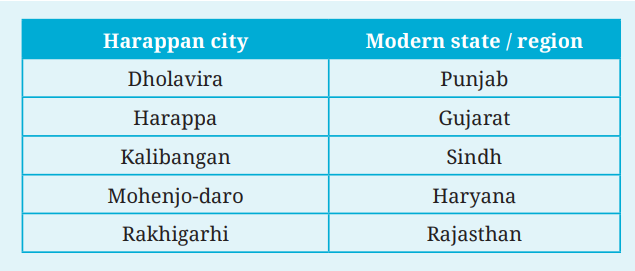
Answer:
| Harappan City | Modern State/Region |
| Dholavira | Gujarat |
| Harappa | Punjab |
| Kalibangan | Rajasthan |
| Mohenjo-daro | Sindh |
| Rakhigarhi | Haryana |
LET’S EXPLORE (Page No. 93)
Q1: Have a debate in class about the last two interpretations. Can you think of any others? Remember that in this case, we do not have any other source of history — no inscription, no text, no traveller’s account.
Answer: Do it yourself.
LET’S EXPLORE (Page No. 95)
Q1: As a class activity, measure the length of your classroom, a school corridor or a playground with the help of any measuring tape. Compare these lengths with the length of the largest reservoir in Dholavira.
Answer: Do it yourself
LET’S EXPLORE (Page No. 97)
Q1: Imagine you cook a meal in a Harappan house. What dish or dishes would you prepare, based on the data given above?
Answer: In a Harappan house, a meal would likely include dishes made from wheat or barley, such as flatbreads or porridge. Pulses like lentils could be cooked into stews, along with vegetables. Dairy products such as milk or curd would also be used. Spices like turmeric and ginger might be added for flavour, and fruits such as bananas could be included. The meal would be nutritious and diverse.
LET’S EXPLORE ( Page No. 99)
Q1: Looking at these three Harappan seals with some writing signs, what goes through your mind? Would you like to suggest any interpretations? Let your imagination run!
Answer: The Harappan seals may have been used to identify traders or goods during trade. The animal figures could represent clans, professions, or religious symbols. The writing signs above the animals may have conveyed names or ownership marks. These seals indicate a well-organised trade system and possibly a symbolic or administrative purpose.
LET’S EXPLORE ( Page No. 102)
Q1: Complete the story found on the Lothal pot. How was such a story remembered for more than 4,000 years, in your opinion?
Answer: The story likely teaches the value of intelligence and problem-solving, similar to the tale of the thirsty crow. It survived for over 4,000 years because it was passed down through visual storytelling and shared cultural memory.
Q2: Consider the ‘Dancing Girl’ figurine. What do you make of the attitude the figurine expresses? Observe her bangles covering an entire arm, a practice still visible in parts of Gujarat and Rajasthan. Where else in this chapter can you spot bangles worn in this manner. What conclusion should we draw from this?
Answer: The figurine reflects confidence, grace, and artistic expression. The bangles worn by the figurine resemble practices still seen in parts of Gujarat and Rajasthan, showing cultural continuity from ancient to modern times.
The Beginnings of Indian Civilisation Question Answer (Exercise)
Q1. Why does the civilisation studied in this chapter have several names? Discuss their significance.
Answer: The civilisation studied in this chapter has several names because of the following reasons:
It is called the Harappan civilisation because Harappa was the first site to be discovered and excavated.
It is known as the Indus civilisation since many important cities developed along the Indus River.
It is also called the Indus-Sarasvatī / Sindhu-Sarasvatī civilisation because a large number of settlements were found along the Sarasvatī River basin.
Each name highlights a different geographical and historical aspect of the civilisation.
Q2. Write a brief report (150–200 words) summing up some of the achievements of the Indus-Sarasvatī civilisation.
Answer: The major achievements of the Indus-Sarasvatī civilisation are as follows:
The Harappans built well-planned cities with straight roads and proper layouts.
They developed an advanced drainage and sanitation system, which shows a high civic sense.
They practised efficient water management using wells, reservoirs, and underground drains.
Agriculture was highly developed; they grew wheat, barley, pulses, and cotton.
They were skilled in crafts such as pottery, bead-making, metallurgy, and weaving.
The Harappans carried out active trade within India and with distant regions by land and sea.
Their society shows social balance, as houses of both rich and poor were built with similar quality.
Q3. Imagine you have to travel from the city of Harappa to Kalibangan. What are your different options? Can you make a rough estimation of the amount of time each option might take?
Answer: The possible travel options from Harappa to Kalibangan could be:
River route:
Travel by boats along the Indus River and its tributaries
Faster and suitable for transporting goods
May take a few days
Land route:
Travel by bullock carts or on foot using trade routes
Slower but commonly used
May take several weeks
Combined route:
Using both river and land routes for convenience
This could take around 15-20 days, balancing both travel methods.
But, each option depends on the weather and the route.
Q4: Let us imagine a Harappan man or woman being transported to an average kitchen in today’s India. What are the four or five biggest surprises awaiting them?
Answer: The five surprises a Harappan man or woman might encounter in a modern kitchen in today’s India are as follows:
The use of gas stoves and electric cooking appliances
Refrigerators for food storage
Pressure cookers and mixers
Availability of running water
Use of steel and non-stick utensils
Q5: Looking at all the pictures in this chapter, make a list of the ornaments / gestures / objects that still feel familiar in our 21st century.
Answer: Several ornaments, gestures, and objects used by the Harappans still appear familiar in our daily life today. These include:
Bangles: The Harappan bangles, especially those worn covering the entire arm, are still commonly seen in parts of Gujarat and Rajasthan.
Beads and jewellery: Beaded necklaces and ornaments are still popular forms of decoration.
Namaste gesture: Terracotta figurines showing folded hands resemble the traditional Indian ‘namaste’ gesture.
Cooking utensils: Pots and vessels used for cooking and storing food are similar in shape to those used today.
Toys and games: Objects such as whistles, game boards, and toys show that recreation was important, just as it is today.
These similarities clearly show a strong cultural continuity between the Harappan civilisation and modern Indian society.
Q6: What mindset does the system of reservoirs at Dholavira reflect?
Answer: The system of reservoirs at Dholavira reflects a highly advanced and thoughtful mindset of the Harappans:
It shows scientific planning, as the reservoirs were carefully designed and connected through underground channels.
It reflects foresight, since water was stored for use during dry seasons.
It indicates collective responsibility, as the reservoirs served the entire city.
It suggests the presence of a strong administrative system that organised labour and maintenance.
It highlights the Harappans’ respect for natural resources and sustainability.
Overall, the reservoirs reflect a civilisation that valued planning, discipline, and public welfare.
Q7: In Mohenjo-daro, about 700 wells built with bricks have been counted. They seem to have been regularly maintained and used for several centuries. Discuss the implications.
Answer: The presence of about 700 brick-lined wells in Mohenjo-daro has several important implications:
It shows that the Harappans had an advanced understanding of water supply systems.
The wells being regularly maintained over centuries indicate a stable and efficient municipal administration.
Easy access to water suggests concern for public health and cleanliness.
The use of bricks shows technical skill and standardised construction methods.
It also reflects social equality, as water was accessible to people living in different parts of the city.
These wells highlight the Harappans’ high level of organisation and civic responsibility.
Q8: It is often said that the Harappans had a high civic sense. Discuss the significance of this statement. Do you agree with it? Compare with citizens in a large city of India today.
Answer: The statement that the Harappans had a high civic sense is significant for the following reasons:
Their cities had well-planned layouts, wide streets, and organised housing.
A proper drainage and sanitation system existed, keeping cities clean.
Public facilities such as wells and reservoirs were carefully maintained.
Equal quality of construction suggests a sense of social responsibility.
Comparison with modern Indian cities:
Today’s cities have modern technology and infrastructure.
However, issues like waste disposal, water shortage, and overcrowding are common.
Civic discipline among citizens is often lacking.
Thus, while modern cities are technologically advanced, the civic sense shown by the Harappans remains an example worth learning from.