
Chapter 1 A Bottle of Dew Class 6 Question Answer
A Bottle of Dew Question Answer Class 6 English Poorvi Chapter 1
Let us do these activities before we read (Page 1)
Q1. Circle the picture that matches with each word. Check your answers by sharing them with your classmates and teacher.
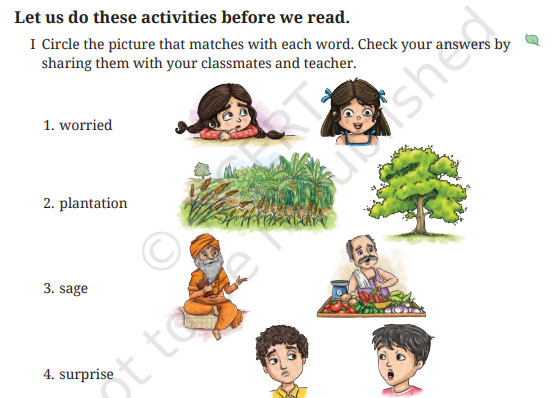
Answer:

II Answer these questions and discuss them with your classmates and teacher.
Q1. Think of a time when you worked hard. What did you do then?
Answer: One time I worked really hard was during my final exams. I made a proper timetable and studied every day. I revised all the chapters, solved practice questions, and cleared my doubts from my teacher. I avoided distractions and focused completely on my goal.
Q2. How did it help you?
Answer: It helped me understand the subjects better and improve my confidence. Because of my hard work, I was able to score good marks in the exams. It also taught me that regular practice and dedication always give positive results.
Q3. How did it make you feel?
Answer: It made me feel proud and satisfied. I felt happy that my efforts were successful. More importantly, I felt motivated to work hard in the future as well.
Let Us Discuss (Page No 3)
Q1. What did Rama Natha believe?
Answer: Rama Natha believed that there was a magical potion that could turn any object into gold.
Q2. How did the sage help Rama Natha?
Answer: The sage, Mahipati, helped Rama Natha by giving him a task. He asked him to plant banana trees, collect the morning dew for years, and bring five litres of it. Through this task, the sage indirectly taught him the value of hard work.
Q3. Do you think Rama Natha will be able to collect the dew? Give a reason.
Answer: Yes, Rama Natha would be able to collect the dew if he worked sincerely and patiently. Since he was determined and planted many banana trees, it was possible for him to collect five litres over time.
Let Us Discuss (Page No 5)
Q1. Why was Rama Natha angry?
Answer: Rama Natha was angry because after working hard for six years and collecting five litres of dew, the potion did not turn the copper vessel into gold. He felt that he had been cheated.
Q2. How did Rama Natha and Madhumati create wealth?
Answer: They created wealth through hard work. Rama Natha planted and took care of the banana trees, while Madhumati sold the bananas in the market. Their teamwork and effort helped them earn money.
Let us think and reflect (Page No 6-7)
I Read the following lines and answer the questions that follow.
1.He spent all his time to learn about the magic potion. People cheated him often, promising to tell him about it, but he did not give up. His wife, Madhumati, was tired of this and also worried because she saw how much money Rama Natha was spending. She was sure that soon they would be without money.
(i) Complete the sentence with a suitable reason.
Rama Natha did not ‘give up’ because _____________________.
Answer: He strongly believed that there was a magic potion that could turn things into gold and believed that one day he would discover its secret.
(ii) Read the column which shows ‘what happened’ and write the correct outcome in the next column.
Answer:
| What Happened | Outcome |
| (a) People promised to tell Rama Natha about the magic potion. | People cheated Rama. |
| (b) Rama Natha was spending a lot of money. | His wife was tired of this. She was sure that soon they would be without money. |
(iii) Write whether the following statements are True or False.
Madhumati was troubled about what her husband did.
Rama Natha was very happy digging his fields.
The sage wanted to show the right path to Rama Natha
Answer: (a) True
(b) False
(c) True
Q2. Carefully, he took the bottle to the sage. The sage smiled and muttered something over the water. Then he returned the bottle and said, “Try it out.” Rama Natha sprinkled a few drops on a copper vessel and waited for it to turn to gold. To his surprise nothing happened!
(i) Choose the option that lists the events given below in the correct order.
- The sage smiled.
- Rama Natha gave the bottle to the sage.
- Rama Natha dropped a few drops of water on a copper vessel.
- He said something in a low voice over the water.
- Rama Natha waited to see if the magic worked.
(a) a, e, d, b, c (b) b, a, d, c, e
(c) c, d, a, b, e (d) a, d, b, e, c
Answer: (b) b, a, d, c, e
(ii) Fill in the blank with the correct word from the lines given above.
Seeing that the plant had dried up, the gardener ____________ some water on it.
Answer: Sprinkled
(iii) How might Rama Natha have felt when nothing happened to the copper vessel?
Answer: Rama Natha might have felt disappointed and cheated when nothing happened to the copper vessel. After working for six years, he believed the potion would work, so its failure upset him deeply.
II. Answer the following questions.
Q1. What did the sage ask Rama Natha to do to make the magic potion?
Answer: The sage asked Rama Natha to plant banana trees, water them himself, collect the morning dew during winter, and store five litres of it in a bottle.
Q2. Why did the sage ask Rama Natha to do everything himself?
Answer: The sage wanted him to learn the value of hard work and responsibility instead of depending on magic.
Q3. How could Rama Natha have a big banana plantation after six years?
Answer: By consistently planting more trees each year and taking proper care of them, he gradually developed a large plantation.
Q4. How did the sage make Rama Natha believe that there is no magic potion?
Answer: The sage showed him the gold coins earned from selling bananas and explained that the wealth came from hard work, not magic.
Q5. Fill in the ‘before’ and ‘after’ table about Rama Natha.
| What he did before meeting the sage | What he did after meeting the sage |
|---|---|
| Neglected his land and chased magical ideas | Worked sincerely on his plantation |
| Wasted money on false promises | Earned wealth through hard work |
Let us learn (Pg 8-9)
- Read the following words from the story.
promised | spending | cheated | luck |
remember | huge | difficult | market |
Use the words correctly to complete the paragraph given below. There are two extra words in the box that you do not need.
There was a farmer who had a ________________ coconut plantation. He worked hard and did not depend on ________________. Every day was _______________ but he did not give up. One day, a man bought a bag of coconuts from him, and _________________ to pay him the money the next day. Days passed and the man did not pay him anything. The farmer felt __________________. About two months later, he met the same man and asked him about his money. The man said, “Oh! I had forgotten. Now, I ______________ buying coconuts from you.” And he paid the money.
Ans. There was a farmer who had a huge coconut plantation. He worked hard and did not depend on luck. Every day was difficult but he did not give up. One day, a man bought a bag of coconuts from him, and promised to pay him the money the next day. Days passed and the man did not pay him anything. The farmer felt cheated. About two months later, he met the same man and asked him about his money. The man said, “Oh! I had forgotten. Now, I remember buying coconuts from you.” And he paid the money.
- Read the words from the story in Column A. Read the new words in Column B. Complete the meanings of the words given in Column B.
The meanings of some words are given.
Column A | Column B | Meaning of words in Column B |
I | eye | |
your | you’re | short form of ‘you are’ |
dew | due | happening at some time in the future |
son | sun | |
one | won | past tense of win |
ate | eight | |
see | sea |
The words given in each row of the table above have the same sounds but different spellings and meanings. Such words are called homophones.
Ans.
Column A | Column B | Meaning of words in Column B |
I | eye | The sense organ in humans and animals to see |
your | you’re | short form of ‘you are’ |
dew | due | happening at some time in the future |
son | sun | A brightest star of our solar system, around which planets revolve. |
one | won | past tense of win |
ate | eight | A number which is one less than nine. |
see | sea | A large body of saltywater that covers most parts of the earth. |
- Choose four pairs of homophones from the table above, and for each pair write a sentence that uses both homophones in the same sentence. Check your answers by sharing them with your teacher and classmates. An example has been given below:
I ate eight bananas for breakfast today.
Ans. I hurt my eye while playing cricket.
You’re holding your book.
The dew is due at dawn, and I have work to do.
The sun was shining on my son.
She won the race by one second.
He ate eight apples.
I can see the sea from here.
- Match the phrases in Column A with the phrases in Column B. Use the connecting words given in the middle column to make meaningful sentences.
Column A | Connecting Words | Column B |
The children submitted their work (When?) | because before as soon as as | the bell rang. |
He did not want to try rock climbing (Why?) | there was a traffic jam. | |
The children ran towards the gate (When?) | the deadline. | |
Nitin was late to school today (Why ?) | of his fear of heights. |
Now, write the new sentences in your notebook.
Ans.
The children submitted their work before the deadline.
He didn’t want to try rock climbing because of his fear of heights.
The children ran towards the gate as soon as the bell rang.
Nitin was late to school today as there was a traffic jam.
Question 5.
Here are two sentences with letter ‘b’.
Read them slowly the first time. As you read them a few more times, read them faster each time.
“Bunty bhaiya bought a big bunch of bananas.
A big bunch of bananas was bought by Bunty bhaiya.”
Now, try to create a tongue twister on your own and share it with your peers.
Answer: Common tongue twisters
- Brave brown bears bake big butter biscuits.
- How much wood would a woodchuck chuck if a woodchuck could chuck wood.
- Busy blue birds build bright bamboo bridges.
- Clever cats climb cold concrete columns.
- She sells sea shells by the sea shore.
- Crazy crabs crawl across crowded coral caves.
- Silent snakes slide smoothly through sandy soil.
- The sixth sick sheep stays in shelter of the shepherd.
Let us listen
Q1: You will listen to what Madhumati does with the bananas from her plantation. As you listen, number the events in the correct order in which they happen. Write the number in the box beside each event.
(refer to page 36 for transcript)
- Gives two bananas to a boy who is hungry
- Meets her friend Kalawati in the market
- Visits her mother and gives her two dozen bananas
- Chooses to go home as only some bananas were left
- Visits her neighbour and gifts them a bunch of bananas
- Gives twelve bananas to her friend
- Goes to the market to sell the bananas
Answer: Correct order of events:
- Visits her mother and gives her two dozen bananas.
- Goes to the market to sell the bananas.
- Meets her friend Kalawati in the market.
- Gives twelve bananas to her friend.
- Chooses to go home as only some bananas were left.
- Gives two bananas to a boy who is hungry.
- Visits her neighbour and gifts them a bunch of bananas.