
NCERT Solutions for Class 6 Science Chapter 5
Let us enhance our learning (pages 97-99)
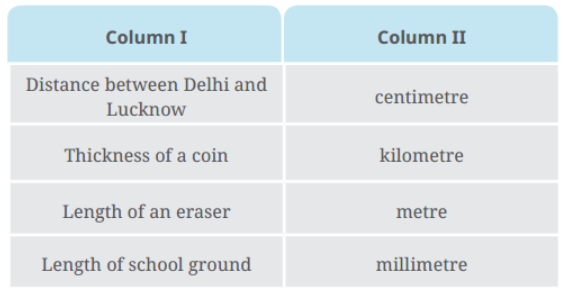
Q1. Some lengths are given in Column I of Table 5.5. Some units are given in Column II. Match the lengths with the units suitable for measuring those lengths
Ans:
| Column I | Column II |
| Distance between Delhi and Lucknow | kilometre |
| Thickness of a coin | millimetre |
| Length of an eraser | centimetre |
| Length of school ground | metre |
Q2: Read the following statements and mark True (T) or False (F) against each.
(i) The motion of a car moving on a straight road is an example of linear motion.
Ans: True
(ii) Any object which is changing its position with respect to a reference point with time is said to be in motion.
Ans: True
(iii) 1 km = 100 cm
Ans: False
Q3: Which of the following is not a standard unit of measuring length?
(i) millimetre
(ii) centimetre
(iii) kilometre
(iv) handspan
Ans: (iv) handspan
Q4: Search for the different scales or measuring tapes at your home and school. Find out the smallest value that can be measured using each of these scales. Record your observations in a tabular form.
Ans: Various measuring scales and tapes have different least counts (smallest value they can measure). The observations are recorded below:
| S. No. | Measuring Instrument | Smallest Value (Least Count) |
|---|---|---|
| 1. | Plastic ruler (15 cm) | 1 mm (0.1 cm) |
| 2. | Steel ruler (30 cm) | 1 mm (0.1 cm) |
| 3. | Measuring tape (tailor’s) | 1 mm (0.1 cm) |
| 4. | Measuring tape (long) | 1 mm (0.1 cm) |
| 5. | Meter scale | 1 mm (0.1 cm) |
Q5. Suppose the distance between your school and home is 1.5 km. Express it in metres.
Ans: 1 km = 1000 metres
1.5 km = 1.5 × 1000 metres
= 1500 metres
Q6. Take a tumbler or a bottle. Measure the length of the curved part of the base of glass or bottle and record it.
Ans: