NCERT Solutions for Class 6 Science Chapter 4
Let us enhance our learning (pages 74-76)
Q1. Fill in the blanks
(i) Unlike poles of two magnets ______ each other, whereas like poles ______ each other.
Ans: Unlike poles of two magnets attract each other, whereas like poles repel each other.
(ii) The materials that are attracted towards a magnet are called ______ .
Ans: The materials that are attracted towards a magnet are called magnetic materials.
(iii) The needle of a magnetic compass rests along the ______ direction.
Ans: The needle of a magnetic compass rests along the north-south direction.
(iv) A magnet always has ______ poles.
Ans: A magnet always has two poles.
Q2. State whether the following statements are True (T) or False (F).
(i) A magnet can be broken into pieces to obtain a single pole. [ ]
Ans: False
(ii) Similar poles of a magnet repel each other. [ ]
Ans: True
(iii) Iron filings mostly stick in the middle of a bar magnet when it is brought near them. [ ]
Ans: False
(iv) A freely suspended bar magnet always aligns with the north-south direction. [ ]
Ans: True
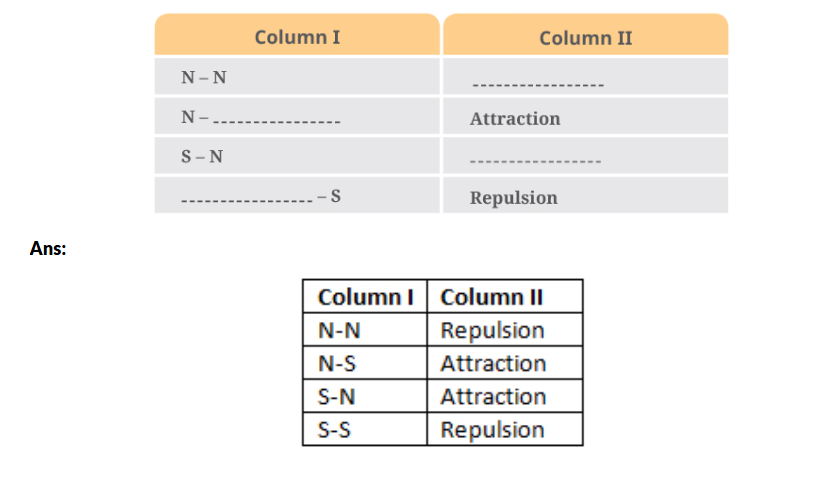
Q3. Column I shows different positions in which one pole of a magnet is placed near that of the other. Column II indicates the resulting interaction between them for different situations. Fill in the blanks
Q4: Atharv performed an experiment in which he took a bar magnet and rolled it over a heap of steel U-clips. According to you, which of the options given in Table 4.3 is likely to be his observation?
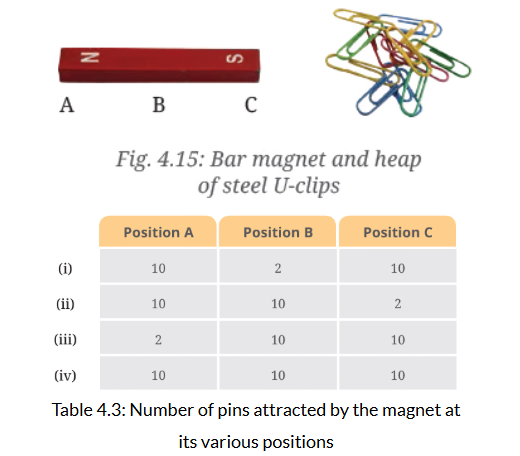
Ans: In Atharv’s experiment, the bar magnet will attract the most U-clips at the poles (positions A and C) and the least at the middle (position B). This is because the magnetic force is strongest at the poles and weakest at the middle.
- Position A (North Pole): High attraction
- Position B (Middle): Low attraction
- Position C (South Pole): High attraction
So, the observation (i) 10, 2, 10 will be his observation.
Q5. Reshma bought three identical metal bars from the market. Out of these bars, two were magnets and one was just a piece of iron. How will she identify which two amongst the three could be magnets (without using any other material)?
Ans: Reshma can identify the magnets by using the property of repulsion, as only magnets can repel each other.
She should bring one end of a bar close to the end of another bar.
If repulsion occurs, then both bars are magnets.
If there is only attraction, then one of them may be iron.
She should repeat this process with different combinations of the three bars.
The pair of bars that show repulsion are the magnets, because a piece of iron is always attracted and never repels.
Q6. You are given a magnet which does not have the poles marked. How can you find its poles with the help of another magnet which has its poles marked?
Ans: To find the poles of the given magnet, we can use another magnet with known poles. Bring the North pole of the known magnet near one end of the given magnet.
If repulsion occurs, that end of the given magnet is also the North pole.
If attraction occurs, that end is the South pole.
Repeat the same with the other end to confirm.
Q7. A bar magnet has no markings to indicate its poles. How would you find out near which end its North pole is located without using another magnet?
Ans: A freely suspended magnet always comes to rest in the north-south direction. I’ll Suspend the bar magnet with a thread tied at its middle so that it can rotate freely. Allow it to come to rest.
The end that points towards the north direction is the North pole.
The other end pointing towards the south is the South pole.
Q8. If the earth is itself a magnet, can you guess the poles of earth’s magnet by looking at the direction of the magnetic compass?
Q9. While a mechanic was repairing a gadget using a screw driver, the steel screws kept falling down. Suggest a way to solve the problem of the mechanic on the basis of what you have learnt in this chapter.
Ans: The mechanic can magnetise the screwdriver by rubbing it with a magnet in one direction. This will make the screwdriver attract the steel screws, preventing them from falling.
Q10. Two ring magnets X and Y are arranged as shown in Fig. 4.16. It is observed that the magnet X does not move down further. What could be the possible reason? Suggest a way to bring the magnet X in contact with magnet Y, without pushing either of the magnets.
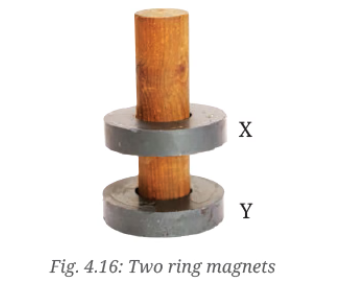
Ans: The possible reason is that the like poles of magnets X and Y are facing each other, due to which they repel each other and magnet X does not move down further.
To bring magnet X in contact with magnet Y, we can reverse one of the magnets so that unlike poles face each other, which will result in attraction.
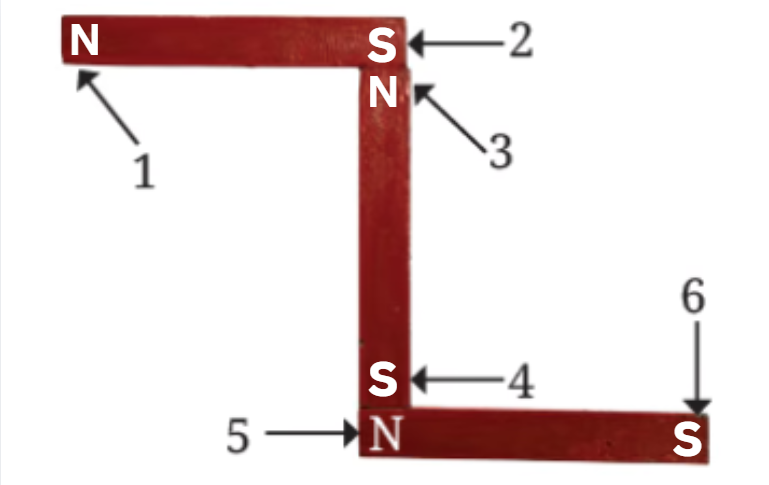
Q11. Three magnets are arranged on a table in the form of the shape shown in Fig. 4.17. What is the polarity, N or S, at the ends 1, 2, 3, 4 and 6 of the magnets? Polarity of one end (5) is given for you.
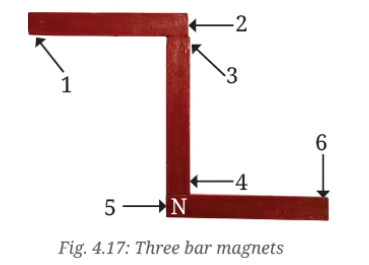
Ans: We know that unlike poles attract each other and like poles repel each other.
Since end 5 is given as North (N), the end of the magnet touching it (end 4) must be South (S).
Now, in the same magnet:
If one end is S (end 4), then the other end (end 3) must be N.
Next magnet:
End 3 (N) will attract end 2, so end 2 = S
Therefore, the other end (end 1) will be N
Last magnet:
End 5 (N) will attract end 6, so end 6 = S
So the final answer is :-